

Tutorial: Plotting projected electronic band structures with solid color and value-scaled width/size
In this tutorial for SrTiO3, we show how to upload your DFT band-structure files, select projection channels, and generate a projected band plot using solid color and value-scaled line/marker sizing.
Step 1: Upload the electronic band structure files #
The first step is to upload the required files from your DFT simulation.
The upload panel indicates which files can be provided.
Not all files are mandatory; however, the file that contains the band information
is essential (for example, PROCAR is required for a VASP simulation).
In this section, you are also asked to provide the Fermi energy. If the Fermi energy
is given, the plot will automatically shift the energies so that the Fermi level is set to zero.
After selecting the files you can proceed by clicking on the Parse button.
Review generated report cards #
After parsing, the page generates report cards that summarize key results. You can expect values such as bandgap, material type, Fermi value, lattice parameters, angles, volume, and density. If the simulation is spin-polarized and the bandgaps differ between channels, the report card shows separate Spin ↑ and Spin ↓ bandgap entries.
If you want this report in different units, use the Units panel in the right sidebar.
| Bandgap | 1.78 eV |
| Type | Semiconductor |
| CBM | Γ (0, 0, 0) |
| VBM | R (1/2, 1/2, 1/2) |
| Direct | False |
| Fermi | 3.48 eV |
| a | 3.94 Å |
| b | 3.94 Å |
| c | 3.94 Å |
| α, β, γ | 90°, 90°, 90° |
| Volume | 61.26 ų |
| Density | 4.97 g/cm³ |
Step 2: Limits and navigation #
Limits
Plot a baseline figure first, then refine the visible energy window from the Limits panel. In this tutorial, set the y-axis limits from -5 eV to 9 eV.
You can also set x-limits by high-symmetry-point index using integer values. In this example, setting x min = 1 and x max = 4 results in plotting the band structure from X to R.
You can generate a baseline figure by clicking Plot, then refine the view using Limits in the right sidebar.
Click Plot to apply the updated limits.
Navigation
Use the quick ribbon controls above the chart to manage interaction behavior while inspecting and presenting figures.
Dark Mode: toggle only the chart styling mode to view the same data in light and dark
figure themes without changing the rest of the page style.
To toggle page dark/light mode, use the top-right button:
 /
/
 .
.
Tooltip: control whether hover readouts and axis-pointer guides are shown. Tooltips are very helpful for inspecting projection contributions. While the axis pointer guides marks the exact x and y position you are of the mouse pointer. Below is an example of a tooltip that appears when you hover over a band segment.
Drag: enable click-and-drag panning of the current zoom window. Use this option to inspect adjacent regions without resetting the zoom.
Zoom Sliders: toggle the axis zoom sliders on or off for interactive zoom control.
Zoom Scroll: enable mouse scroll-wheel zoom interactions. For best results, hold Ctrl while scrolling. You can also hold Ctrl without enabling Zoom Scroll to quickly zoom in and out around the mouse focus.
Zoom Window: enable zooming into a specific rectangular region in a single action.
Step 3: Add projections and configure projected-style panels #
Click Add Projection to create a projection card. In projected-solid mode, the projection panels below mirror the live card controls, so style updates in the main page carry over automatically.
Smart Plotting Order helps keep overlapping projected traces readable by automatically
drawing projections with smaller projections on top, so smaller projections are less likely to be hidden
under dominant projections. Keep in mind that when projections are very close to each other
(for example, 45% and 55%), this can become slightly unreliable. If you disable it, drawing order
follows each projection's Plot Order value (or default ordering when left as
auto).
The app automatically enables Plot projected bands and disables Plot plain bands after the first projection is added; you can re-enable plain bands if you want overlays.
Each projection card is an independent projected-band trace. After adding a projection, select the atom, orbital, and (if applicable) spin entries in the projection table for exactly the contribution you want to visualize. You can stack multiple projections to compare different chemical or orbital channels in the same plot.
Use the Coloring panel to keep mode on Solid color, and use Line/Marker to enable Value-scaled width/size for projection-strength emphasis.
In the Coloring panel, Opacity sets transparency for the full projection trace
(0 = fully transparent, 1 = fully opaque), which is useful when several projections overlap. Use
Plot Order to control stacking: projections with higher values are drawn on top of lower
values, while auto keeps the default app ordering.
For meaningful comparisons across multiple projections, keep key style scales consistent across cards, especially line width and marker size. If one projection uses a much larger base size than another, visual differences can come from styling rather than the actual projection weights.
After defining projections, click Plot to render the projected bands. If needed, refine line style, marker type, opacity, and labels in each card before plotting again.
Step 4: Example projection choices for SrTiO3 #
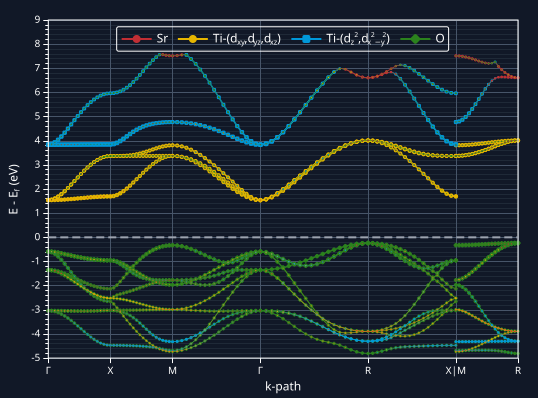
In this example, we use four projections: one for Sr, two for Ti, and one for O. Keep line width and marker size settings consistent across projections for a fair visual comparison.
For this example we selected the shine color pallet: Sr in Red (#c12e34) ; Ti
t2g (dxy, dyz, dxz)
in Yellow (#e6b600); Ti eg (dz2,
dx2-y2) in Blue (#0098d9); and O in Green
(#2b821d).
After confirming your projection selections, click Plot to generate the projected electronic band structure.
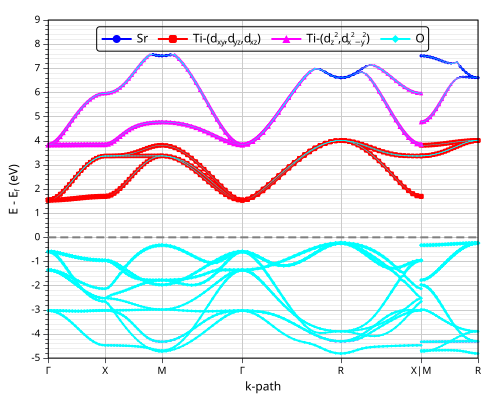
Step 5: Show and tune the legend #
Legend labels are automatically generated from each projection selection based on the selected atoms/orbitals. If you want a custom label, use the legend panel inside that projection card. In the same per-projection legend panel, you can also adjust label styling such as color, weight, and style.
The global Legend panel in the right sidebar controls figure-level legend behavior.
Use it to show/hide the legend, choose from preset positions (for example
Upper Right, Upper Center, Center, and
Lower Left), or switch to Custom to manually place the legend.
When Custom is selected, Loc. X and Loc. Y are activated.
You can also tune layout (Orientation, item Length/Width,
marker count/size, and Gap), plus style controls including background, font size,
plot order, and border settings (color, width, and radius).
In this example, we set Position to Upper Center, enable Border, and set Radius equal to 2.
During analysis, you can hide or unhide individual projections by clicking legend entries as shown below.
Step 6: Customization and styling #
For axis, legend, font, colors, and other appearance controls, use the right sidebar and see the full settings reference in Plot Settings.
Step 7: Export the figure #
When your figure is ready, click the download button in the chart toolbar to export it. Use this to save a clean image for reports, slides, or publications.
If you download SVG, the figure and element positions remain fully editable when opened in software such as Adobe Illustrator, Inkscape, or GIMP.
Step 8: Preserve the SVG text font appearance #
If you download an SVG and open it on another computer that does not have the same fonts, the text may fall back to default system fonts and look different.
To lock the typography, open the SVG in a graphics editor such as Adobe Illustrator, Inkscape, or GIMP, and convert text to paths/curves.
Keep an editable master copy before converting text, because path/curve text is no longer editable as normal text.