Electronic band structure
This page documents the Electronic Band Structure (EBS) workflow in detail. It covers required files, parsing behavior, plain and projected plotting, projection controls, projection tables, axis behavior, and export.
The workflow is code-agnostic: upload the files required by your selected parser/code, parse, configure
plain/projected rendering, and export. Where useful, this page uses VASP file names
(PROCAR, KPOINTS, POSCAR) as concrete examples.
For full styling controls shared across EBS and DOS (figure, title, axes, grid, legend), see Plot Settings.
_colormap.svg)
_colormap_dark.svg)
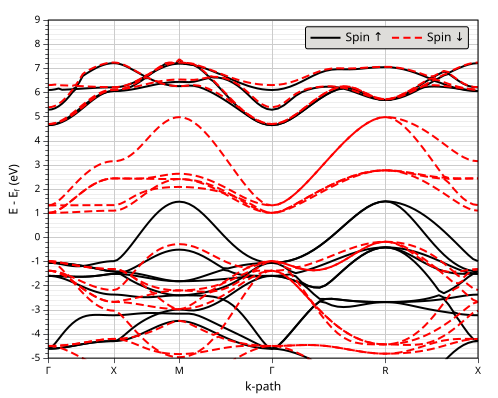
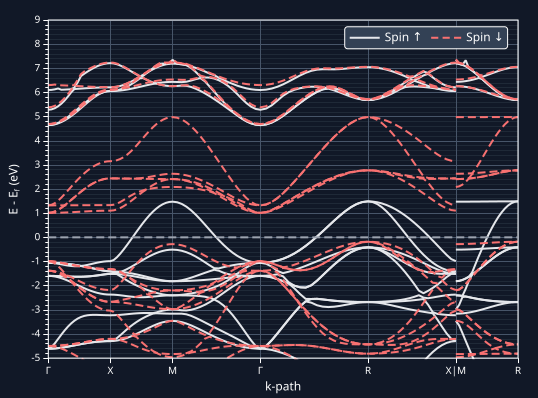
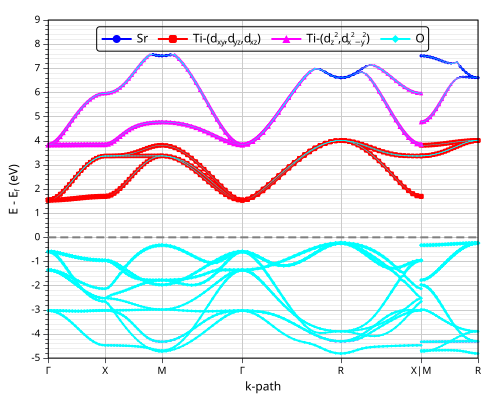
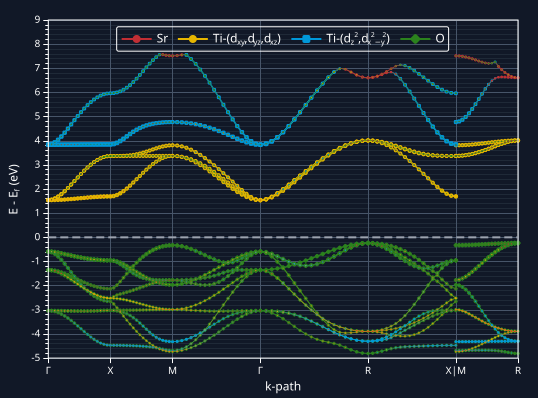
Input and parsing #
EBS requires band/projection data and optionally path/structure metadata. The exact file names depend on the DFT code/parser. In the current UI, the visible fields are VASP-style examples: PROCAR, KPOINTS, and POSCAR.
After Parse, the parser returns band/projection arrays and metadata
(spins, bands, atoms, k-path, energy limits, and species information when available).
If Fermi Energy is provided, energies are shifted to
E - EF and axis labeling is adjusted accordingly.
Although this section resembles uploading files to a website, your files never leave your computer. Parsing and plotting run locally in your browser.
| File | Required | Purpose |
|---|---|---|
PROCAR
|
Yes | Band energies and orbital projections used for plain and projected plotting (VASP example). |
KPOINTS
|
No | Improves k-path/high-symmetry labels and segment interpretation (VASP example). |
POSCAR
|
No | Provides species/count metadata for grouped atom tables (species rows, VASP example). |
Required files: required inputs are validated before parsing, and missing files are highlighted in the form.
Fermi Energy: enter a valid numeric value to shift energies by
E - EF after parsing.
Parse: click parse to load metadata and projected bands; a processing overlay is shown while parsing.
Status handling: parse success/failure is reported to the UI and logged for telemetry.
General plot options #
Plot plain bands: plot plain band lines from parsed eigenvalue data.
Plot projected bands: plot projected/weighted bands from one or more projections.
Smoothing: adjust smoothing tension from 0 to 1; use 0 for no smoothing and 1 for maximum smoothing. ECharts applies smooth line interpolation (Bezier-style) using this factor.
Plain and projected bands can be enabled together for overlay comparisons.
Line/marker panel
The Line/Marker panel in General Options controls the style of plain-band traces.
Line: choose the line style (Solid,
Dashed, or Dotted).
Width: customize the plot lines line width by modifying this field. The units are pixels.
Marker: choose the marker type (None,
Circle, Square,
Triangle, or Diamond).
Size: set marker size in pixels.
Color: customize the line and marker color using the color picker. The appearance of the color picker is defined by the browser. In Firefox, to select a custom color you need to click on the “+” icon.
Opacity: set the opacity of line and marker style to any value between 0 and 1, where 0 means fully transparent and 1 means fully opaque.
Plot Order: control drawing stack priority; higher values are
drawn on top of lower values, while auto keeps default ordering.
Legend panel
The Legend Panel in General Options controls the legend label text and label style for plain-band traces.
Include: enable or disable that trace in the legend. When unchecked, the corresponding legend entry is hidden.
Label: set the legend label text for the trace.
Color: customize the legend label color using the color picker. The appearance of the color picker is defined by the browser. In Firefox, to select a custom color you need to click on the “+” icon.
Weight: customize the font weight using this dropdown. The options correspond to font-thin, font-extralight, font-light, font-normal, font-medium, font-semibold, font-bold, font-extrabold, and font-black, which map to 100, 200, 300, 400, 500, 600, 700, 800, and 900, respectively. Most fonts only provide a subset of these weights (typically normal and bold). You can see examples of fonts that support all weights in Google Fonts.
Style: customize the font style as normal or italic.
Fermi level panel
The Fermi level panel in General Options controls the horizontal Fermi reference line drawn in the plot.
Show fermi: enable or disable the Fermi reference line.
Shift: apply an additional energy offset before plotting.
The displayed energy reference follows
E - (EF + shift), and the shift unit follows the selected
energy unit in the Units panel.
In EBS, the base Fermi reference comes from the Fermi Energy value entered in the input section before parsing.
Line, Width, Color: control the visual style of the Fermi line.
Opacity: set the opacity of fermi line to any value between 0 and 1, where 0 means fully transparent and 1 means fully opaque.
Plot Order: control rendering priority relative to other traces and overlays.
Bandgap panel
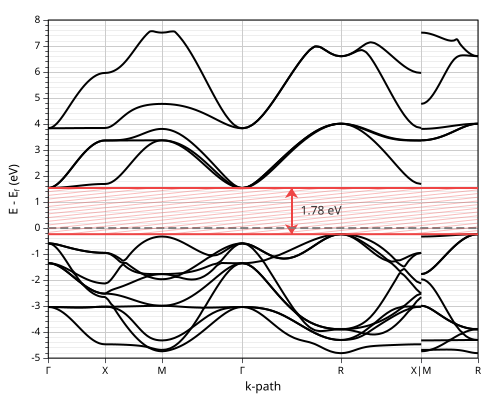
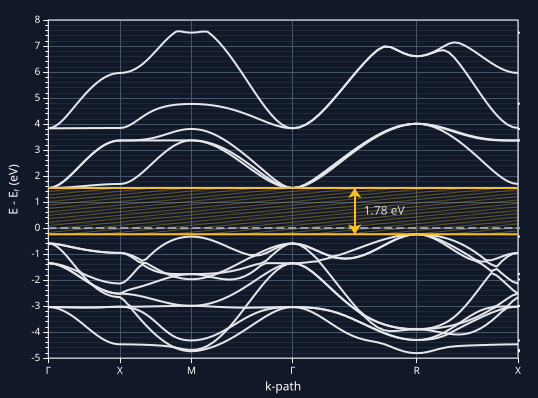
The Bandgap panel in General Options controls the guide lines and annotations used to visualize the gap.
Show bandgap: enable or disable bandgap guides and labels.
Color, Line, Width: control the style of the bandgap guide lines.
Length: set guide extent to none,
partial, or full.
Fill: choose how the gap region is rendered:
none, hash, or solid.
Arrow: show or hide directional arrow markers.
Value: show or hide the numeric gap label in the selected energy unit.
In EBS, bandgap guides are derived from the valence-band maximum and conduction-band minimum found in the plotted band data.
Projected bands workflow #
Projected plotting requires projected data and at least one projection card. If projected data is unavailable, adding projections is disabled.
+ Add Projection: add a new projection card with projection-table selection and style controls.
Smart Plotting Order: when enabled, projections with smaller projected contribution are plotted on top.
First projection behavior: first-time projection creation enables projected mode; plain and projected curves can still be rendered together afterward.
Projection scope: each projection has independent projection selections, label controls, and visual styling.
Projection removal: remove projections individually without affecting other projection cards.
Projection cards #
Each projection has a set of control panels that map directly to options consumed by the plotting pipeline.
Coloring panel
Color / Colormap: choose between a single solid color and colormap-based rendering for each projection.
Color: when Color is selected, use the color picker to set the projection color.
Colormap: when Colormap is selected, choose the palette used to map projected values.
Reverse: reverse the colormap direction.
Opacity: control projection transparency from 0 to 1.
Plot Order: control drawing stack priority; higher values are drawn on top.
Line and marker panel
Line: select line style from None, Solid, Dashed, and Dotted.
Width: set line width in pixels. This field is disabled when Line is None.
Marker: select marker type from None, Circle, Square, Triangle, and Diamond.
Size: set marker size in pixels. This field is disabled when Marker is None.
Value-scaled width/size: in electronic band structure projections, scale line width and marker size using projected values.
Spins/values panel
Spin ↑ / Spin ↓: select which spin channels are included for this projection. This option is available only for spin-polarized calculations.
vmin: set the lower bound for colormap normalization.
vmax: set the upper bound for colormap normalization.
Normalize: this does not perform a quantum-mechanical normalization. It only rescales the selected projection values so they add up to one for plotting. Projection values depend on the selected projection basis and projection radii, and the selected set may be incomplete.
Legend panel
Include: enable or disable that projection in the legend. When unchecked, the projection legend entry is hidden.
Legend Label: enter custom legend text for the projection. Leave this field empty to use the auto-generated label from your projection selection.
Color: customize the legend label color using the color picker. The appearance of the color picker is defined by the browser. In Firefox, to select a custom color you need to click on the “+” icon.
Weight: customize the font weight using this dropdown. The options correspond to font-thin, font-extralight, font-light, font-normal, font-medium, font-semibold, font-bold, font-extrabold, and font-black, which map to 100, 200, 300, 400, 500, 600, 700, 800, and 900, respectively. Most fonts only provide a subset of these weights (typically normal and bold). You can see examples of fonts that support all weights in Google Fonts.
Style: customize the font style as normal or italic.
Projection table (atoms, orbitals, and spin channels) #
For each projection, the projection table controls exactly which site/orbital/spin contributions are included in the sum. The table behavior depends on which structural metadata is available after parsing.
Rows: rows represent atoms by default, or species-grouped atoms when structure metadata matches parsed atom counts.
Columns: columns include orbital channels (s, p,
d) and, for non-collinear data, magnetization channels.
Species controls: species headers are collapsible and include species-level checkbox controls.
All: row-level and species-level selection supports indeterminate states when only part of a group is selected.
When only projection data is available (or structure matching fails), the table is shown as generic atom rows. This is still fully functional, but less chemically expressive.
When structure metadata is present through a structure file (e.g. POSCAR) and is consistent with the projected bands file (e.g. PROCAR), atoms are grouped by species. This makes projection setup faster for multi-element systems because you can apply selections across an entire species block before refining individual atoms.
Additional spin/magnetization columns appear for non-collinear calculations. This enables direction-resolved projection analysis in the same table workflow used for orbital selection.
Axis and rendering #
X axis path labels: high-symmetry labels and boundaries are generated from parsed k-path metadata.
Boundary handling: boundary labels such as K|U are split adaptively at zoom
edges.
Minor x ticks: minor x ticks and split lines are disabled in custom EBS axis rendering.
Y range: y-axis limits are auto-expanded when color maps or legends require extra vertical room.
Fermi line: when enabled, a horizontal Fermi reference line is drawn above data series.
Projected rendering: projected bands use custom ECharts series for weighted color mapping and performance.
Markers: scatter markers can be layered and optionally scaled by projection weight.
Renderer: plot rendering can use canvas or SVG, with export choosing the appropriate renderer by format.
Navigation #
Use the quick ribbon controls above the chart to manage interaction behavior while inspecting and presenting figures.
Dark Mode: toggle only the chart styling mode to view the same data in light and dark
figure themes without changing the rest of the page style.
To toggle page dark/light mode, use the top-right button:
 /
/
 .
.
Tooltip: control whether hover readouts and axis-pointer guides are shown. Tooltips are very helpful for inspecting projection contributions. While the axis pointer guides marks the exact x and y position you are of the mouse pointer. Below is an example of a tooltip that appears when you hover over a band segment.
Drag: enable click-and-drag panning of the current zoom window. Use this option to inspect adjacent regions without resetting the zoom.
Zoom Sliders: toggle the axis zoom sliders on or off for interactive zoom control.
Zoom Scroll: enable mouse scroll-wheel zoom interactions. For best results, hold Ctrl while scrolling. You can also hold Ctrl without enabling Zoom Scroll to quickly zoom in and out around the mouse focus.
Zoom Window: enable zooming into a specific rectangular region in a single action.
Plot and export #
Use Plot to render, Reset to clear, and Download to export. Export supports PNG, JPEG, and SVG.
Download behavior uses an export helper that requests the required renderer per format (SVG renderer for SVG export; canvas renderer for PNG/JPEG).
If you download SVG, the figure and element positions remain fully editable when opened in software such as Adobe Illustrator, Inkscape, or GIMP.
Warnings and errors #
Invalid settings: "Some settings are invalid. Please review highlighted fields before plotting." This appears when one or more inputs fail validation. Review highlighted fields in the right sidebar, correct them, then plot again.
Missing required upload: "Missing required file: PROCAR. Please select it before parsing." The required file name depends on the selected parser/code. Upload the mandatory file first, then click Parse again.
Invalid Fermi input: "Invalid Fermi energy. Please enter a valid number." This appears when the Fermi field is empty or not numeric. Enter a valid decimal value and re-parse.
K-path warning: "Uploaded KPOINTS is not a 1D line-mode k-path..." This means the path file is not in the expected line-mode format for band-path labeling. Use a matching line-mode path file from the same run for reliable x-axis labels.
Parse failure: "Failed to parse files. Please check inputs and try again." If more details are available, parser-provided text is shown. Common causes are corrupted files, wrong file types, or mixed files from different calculations.
Parse required: "Parsing required: click Parse before plotting (the last parse may have failed)." This appears when plotting is requested before a successful parse cycle. Re-run Parse and confirm parsing completes.
No plot mode selected: "Select at least one plotting mode: plain or projected." Enable either plain bands, projected bands, or both before plotting.
Projected mode without projections: "To plot projected bands, select at least one projection. Otherwise, use Plot plain bands." Add at least one projection card or disable projected mode.
Spin selection required: "Projection N: select at least one spin channel (Spin ∣↑⟩ or Spin ∣↓⟩)." Each active projection must have at least one spin channel enabled to contribute data.
Colormap restriction: "Plot blocked: when using multiple projections, all projections must use solid coloring. Only a single colormap projection is supported." If you need several projections at once, switch them to solid mode; keep colormap for a single projection only.
X-limit validation: "X min and X max must be integers (k-tick indices)." and "X min and X max must be between 0 and N (inclusive)." Use valid integer tick indices within the parsed k-path range.
Export before plotting: "Plot bands first, then export." Export is available only after a successful rendered plot exists.
Spin-toggle guard: "At least one spin channel must stay selected." This prevents an invalid empty-spin state. Keep at least one spin channel checked.
Runtime plotting errors: "Failed to plot projected bands: ..." This is a catch-all runtime failure during plot construction. Re-check projection configuration and parsed input consistency, then retry.
For parser-specific input requirements by code, refer to the corresponding code parser documentation.